

TLDR
United States: As far as the US market is concerned, MFN seems to be having minimal impact so far. This may change if GLOBE / GUARD are implemented.
Other countries: MFN is contributing to ex-US drug launch delays and withdrawals. It’s unclear whether this reflects a new steady state or temporary uncertainty around MFN.
Note: This is Part 2 of a 3-part MFN series, building on the MFN framework (Part 1) and its uneven consequences across drugs. Part 3 will cover implications for value and evidence strategies.
US Impact: Limited So Far
The Trump Administration has estimated that MFN will reduce US drug spending by $529B over the next decade. But so far there is little evidence backing up this claim.
Bilateral manufacturer agreements (voluntary) and GENEROUS (voluntary) have largely focused on Medicaid, where drug prices are already low and may not be impacted much by MFN.
Manufacturers are also offering ‘discounted’ drugs through TrumpRx, but these prices may not differ much from what insurers pay already. Some expect TrumpRx to have minimal impact given its focus on uninsured and cash-paying individuals.
GLOBE and GUARD (mandatory) in Medicare would have a much bigger effect, but neither model is finalized and both would start as smaller pilots. Some manufacturers may also be exempted from GLOBE / GUARD via bilateral agreements.
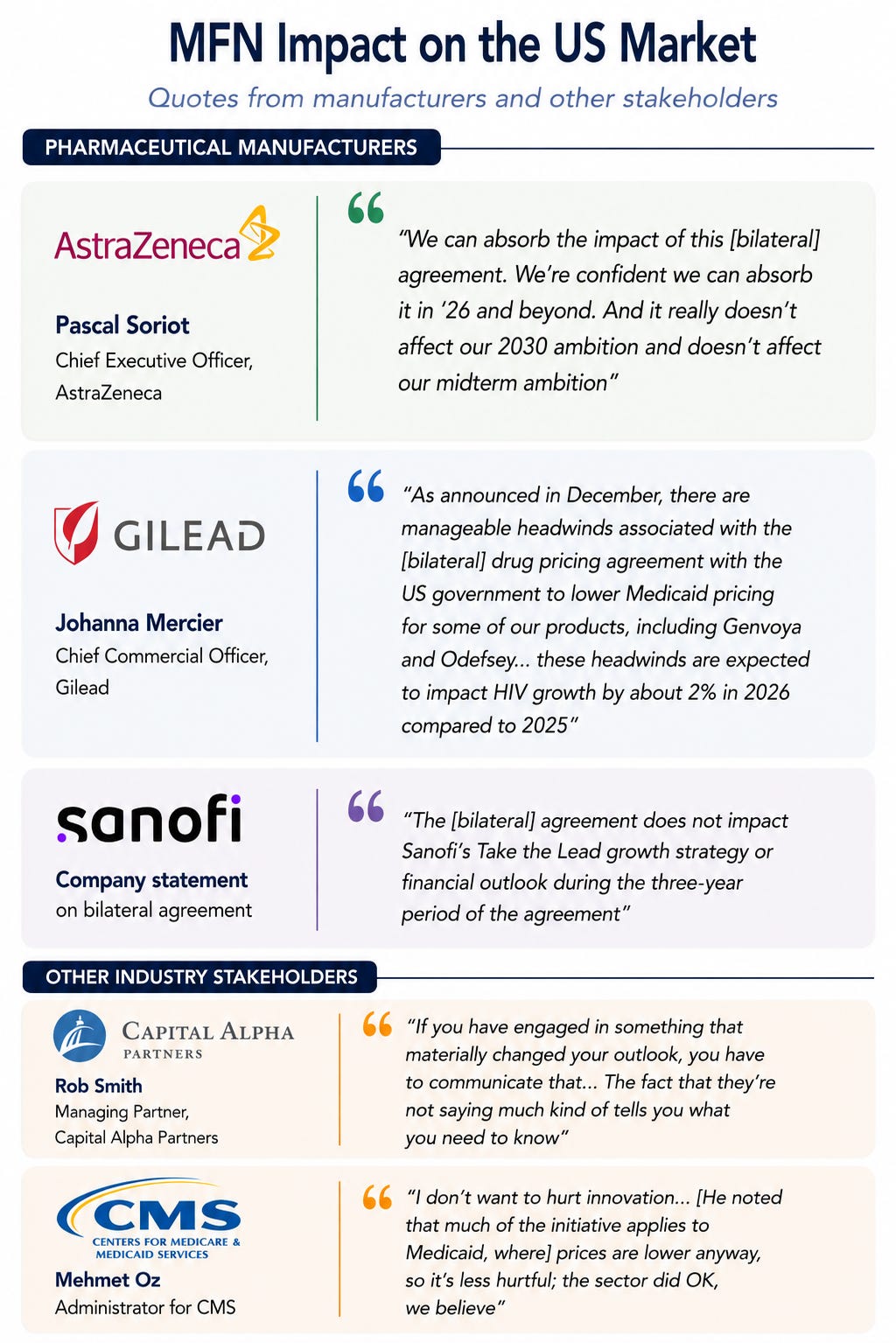
On the whole, MFN does not seem to be having much impact on the US market yet. This has been echoed by manufacturers and others in the industry.1
Ex-US Impact: Storm Clouds on the Horizon
I remember one European ISPOR panel in 2023 with Peter Kolchinsky (RA Capital). During the session he said the following (paraphrased):
“I invest in innovative pharmaceuticals. Before making investments, I forecast revenues for drugs. These days, I treat Europe as a rounding error. I zero out European sales in my forecast models. I’m focused on the US market”
If the European market was being ‘downgraded’ by investors (and, by extension, manufacturers) in 2023, this trend has only continued in recent years.
Drug prices remain much lower in European countries, and country-specific Health Technology Assessments (HTA) are time- and resource-intensive. The EU Joint Clinical Assessment (JCA) has added another big step in this process. Countries like Germany and Italy are seeking even lower drug prices, prompting industry backlash.
MFN is speeding up this divergence between US and ex-US markets, and manufacturers may decide it’s safer to delay or withdraw ex-US access than risk US revenues. The early data seem to point in this direction.
For example, Reuters reported that new drug launches in Europe were ~35% lower in the 10 months after MFN was announced.
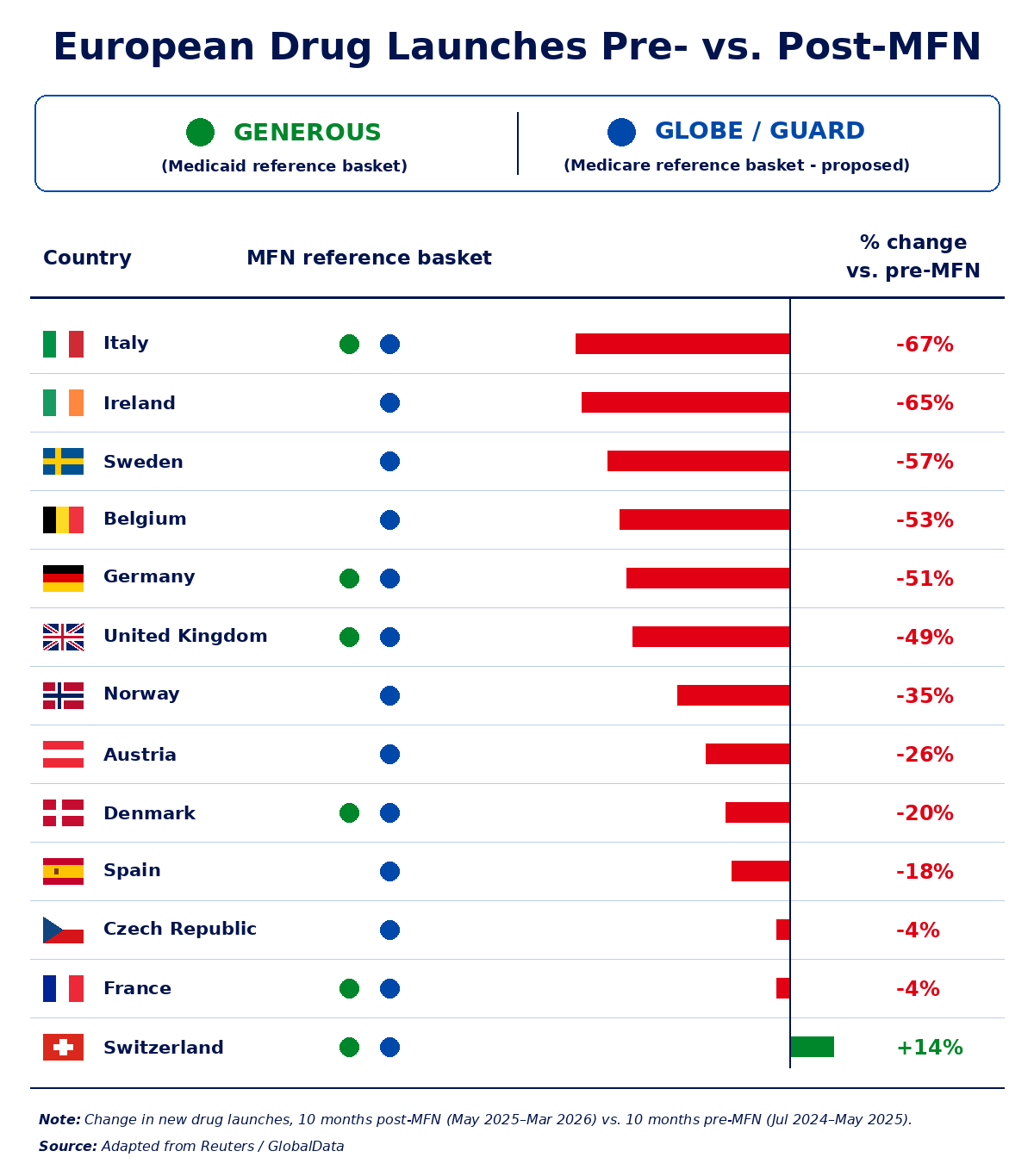
Pharmaceutical Technology has also highlighted more drug withdrawals following MFN. One high-profile example was Amgen’s withdrawal of Repatha from Denmark, widely believed to be driven by MFN.
One question to keep asking ourselves is “which types of drugs are being delayed or withdrawn?” Following our Warped Curve logic, “incremental therapies” should be more exposed here than “breakthroughs”2 - but only time will tell if this pattern holds.
Of course, MFN may not be the only force at play. These trends may reflect a continuation of pre-MFN sentiments toward Europe, compounded by new pricing pressures and the added requirements of JCA. Some manufacturers may simply be sitting on the sidelines until the policy environment becomes clearer.
But… these do feel like early signs that MFN will shrink ex-US access, unless new approaches are taken to boost ex-US drug spending (such as the widely-touted US-UK pharmaceutical trade deal).
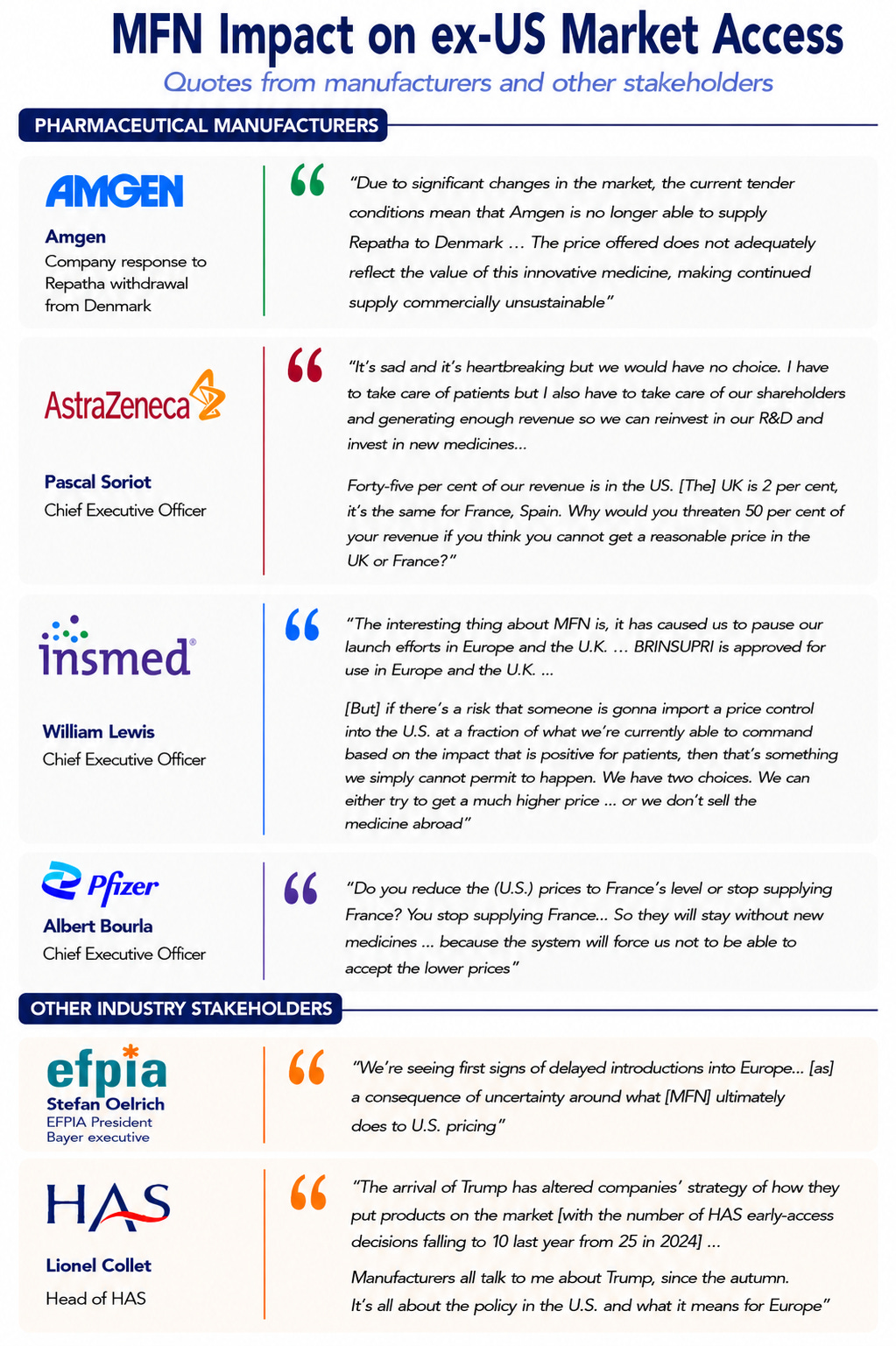
Industry statements support this read of the tea leaves, such as the quotes below.3 Similar sentiments were echoed in a survey of EUCOPE members.
The Takeaway
If ex-US prices are not meaningfully increased, MFN will force manufacturers to make a choice: 1) sacrifice US revenues, or 2) sacrifice ex-US revenues.4 It’s too soon to tell, but early evidence suggests manufacturers are willing to protect US revenues at the expense of ex-US markets.5
In Part 3, we’ll explore what this all means for biopharma market access strategies.
Quote Sources (MFN Impact on the US Market):
I’m using “incremental” and “breakthrough” to distinguish therapies with modest vs. substantial differentiation. Figuring out which is which is usually more art than science!
Quote Sources (MFN Impact on ex-US Market Access):
As discussed in the Warped Curve, sacrificing ex-US sales could also create pressure to raise US prices for some drugs to offset lost revenue
This trade-off is most acute for companies that rely heavily on US revenues. Manufacturers with less US exposure, such as Chinese biotechs, may face fewer constraints - and could fill some gaps left by Western delays / withdrawals. A topic for another day!