

TLDR
The Trump Administration’s MFN framework is coming into focus as a combination of:
Bilateral manufacturer agreements (voluntary)
GENEROUS (Medicaid, voluntary)
GLOBE / GUARD (Medicare, mandatory)
TrumpRx (direct-to-consumer platform)
Trade policy (tariffs, onshoring, ex-US pricing pressure)
In the short term, the impact of MFN on US drug prices may be limited. For new drugs, MFN pricing can be mitigated by delaying ex-US launches. In Medicaid, MFN may not move prices much below current levels.
The key issue to watch will be what happens with GLOBE / GUARD. If finalized, these proposed models would bring MFN prices to Medicare. However, public reporting suggests that bilateral manufacturer agreements have included exemptions from GLOBE / GUARD, which would limit their near-term impact.
Most-Favored Nations (MFN)
When we discussed Most-Favored Nations (MFN) last fall, many of the nitty gritty policy details were still unclear. What was clear is that tying US drug prices to other countries would delay ex-US access, and that impacts would be different for ‘breakthrough’ vs. ‘incremental’ drugs (see the ‘Warped Curve’ graphic below).
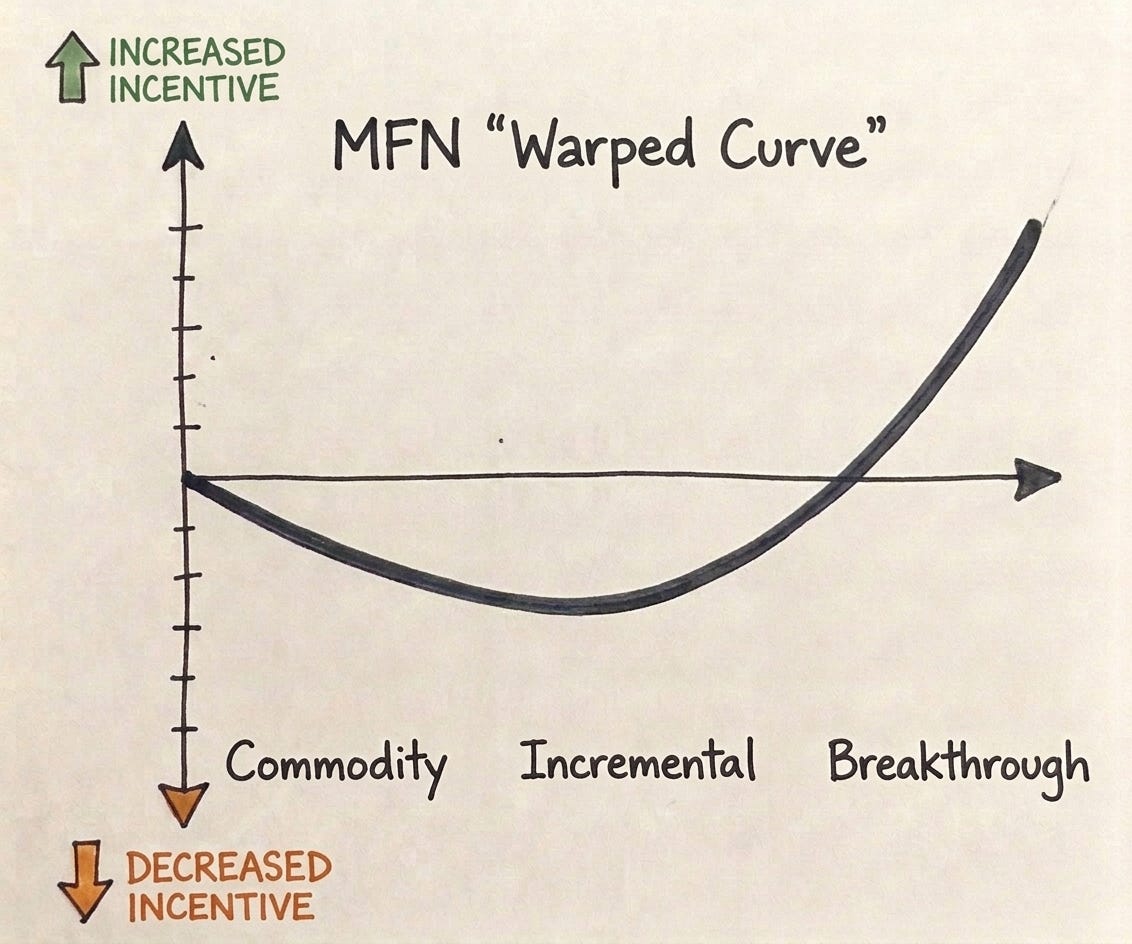
Over the last few months, the MFN framework has become much clearer. Today we’re going to unpack these updates in Part 1 of a 3-part series.
In Part 2, we’ll explore the impacts so far from MFN. In Part 3, we’ll discuss implications for biopharma value and evidence strategies.
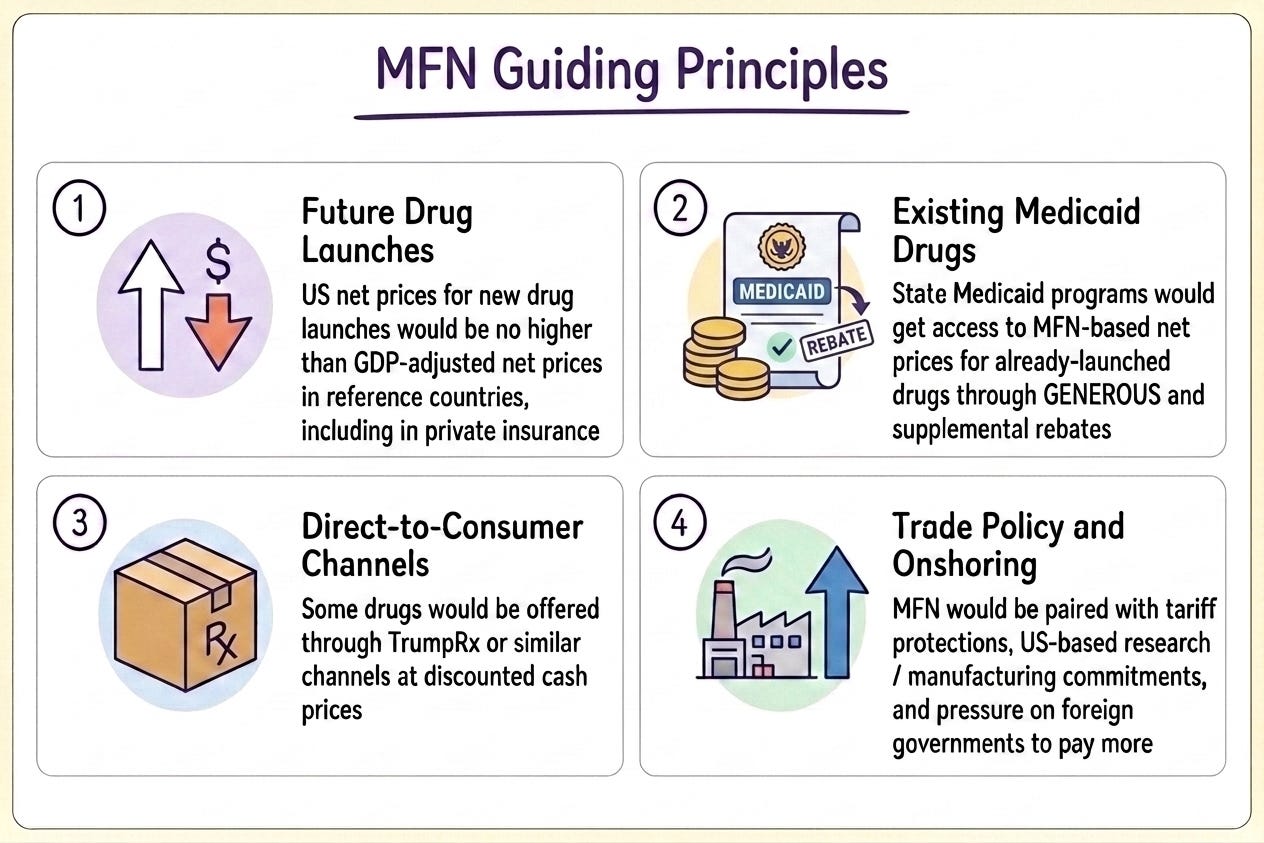
MFN Guiding Principles
Based on public announcements, MFN has been focused on four guiding principles:
MFN Bilateral Agreements and CMMI Models
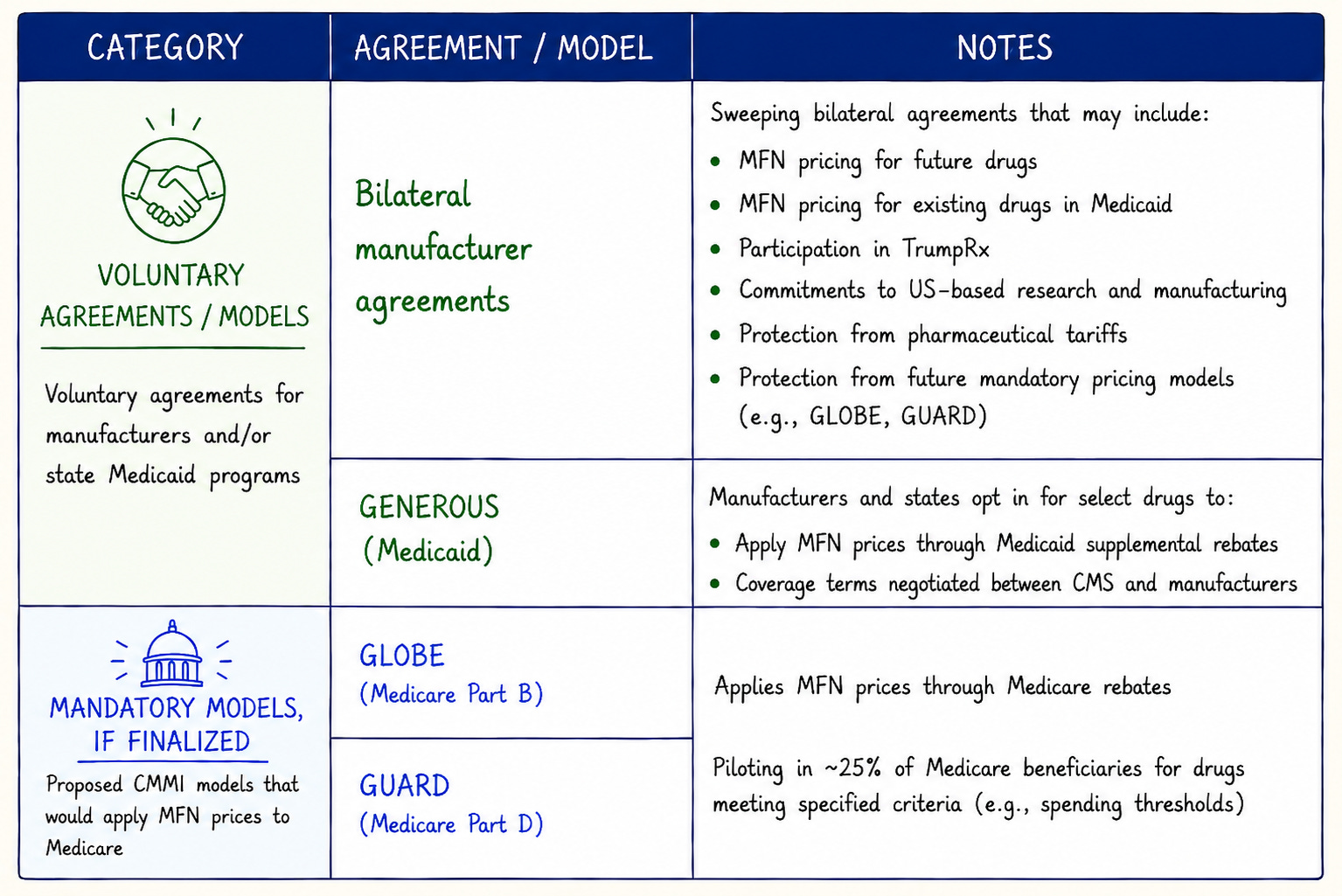
The Trump Administration is using several approaches to operationalize MFN:
Bilateral manufacturer agreements (voluntary)
GENEROUS model (Medicaid, voluntary)
GLOBE / GUARD models (Medicare, mandatory)
Bilateral agreements and GENEROUS depend on manufacturer and/or state participation. GLOBE and GUARD would create mandatory MFN rebates in Medicare.
Bilateral manufacturer agreements
As of May 2026, 17 manufacturers have signed bilateral agreements with the Trump Administration. The terms of these agreements have not been disclosed.
These agreements are thought to include MFN pricing for future drug launches, MFN pricing in Medicaid, participation in TrumpRx, and commitments to US-based research and manufacturing.
In return, manufacturers may receive protection from pharmaceutical tariffs and future mandatory pricing models, such as GLOBE and GUARD.
GENEROUS
GENEROUS is a voluntary CMMI model for Medicaid (2026-2030). Participating manufacturers would provide supplemental rebates to state Medicaid programs to align net prices with MFN prices.
MFN prices would be determined as the second-lowest GDP-adjusted net price reported by manufacturers across eight reference countries: Canada, France, Germany, Italy, Japan, the UK, Denmark, and Switzerland.
Uptake for GENEROUS will depend on participation from manufacturers and state Medicaid programs. CMS will negotiate coverage terms with manufacturers, and states will decide whether to accept those terms. For some drugs, states may have less incentive to participate if they’ve already secured favorable supplemental rebates.
GLOBE / GUARD
GLOBE and GUARD would be mandatory CMMI models for Medicare. GLOBE would apply to Medicare Part B (2026-2031) and GUARD to Medicare Part D (2027-2031).
Both models are proposed and not finalized. If implemented, each would mandate additional rebates when US prices exceed MFN prices based on 19 reference countries.
CMS is planning to pilot these models in selected geographies covering ~25% of Medicare Part B / Part D beneficiaries, and only for drugs meeting specified criteria (e.g., spending thresholds).
GLOBE and GUARD represent a bigger concern for manufacturers. For new drugs, MFN pricing can be mitigated by delaying ex-US launch. In Medicaid, MFN may not move prices much below current levels. But GLOBE and GUARD would lower net prices for high-revenue Medicare drugs.
Public reporting suggests that some bilateral agreements may exempt manufacturers from GLOBE and GUARD, which would be a valuable concession and limit the near-term impact of these models.